

There’s a common narrative about why Canada Post is in such bad shape—the company’s financial difficulties lie in excessive spending, and that the decline of letter-mail has made Canada Post too costly and wasteful to operate in the digital age. Looking at the plans put forward by the federal government and Canada Post management to seek financial sustainability through aggressive cost-cutting, it appears that high-level decision-makers agree.
But there is little substance to such claims.
If we compare the operating costs of postal services around the world, we see that Canada Post’s operating costs are actually well below the average among its peers. This is particularly impressive given the unique challenge of Canada’s vast geography.
And if we track long-term changes in spending and revenue among these other international postal services, we see that spending cuts are a self-defeating strategy for attaining financial sustainability. Reductions in operating costs are strongly associated with falling revenues. Usually, the drop in revenue cancels out what is “gained” through the spending cut, leaving company finances worse off than before.
If we are indeed in a new age of nation-building projects, we ought to reject an approach based on counter-productive cuts. Instead, we should favour bold investments to open up new streams of revenue for Canada Post in sectors like banking or telecommunications, while enhancing its role in public service provision.
A global dataset of Canada’s peer postal services
To compare the cost of operating Canada Post with those of similar postal services, we created an international dataset for the designated postal operators of 20 peer countries, including Canada.
This dataset combines information from the annual reports of designated postal operators with the latest postal statistics available from the Universal Postal Union’s (UPU) Postal Statistics Database (2023).
All of these postal services have some form of Universal Service Obligation (USO), meaning that they are required to provide a reliable and affordable mail service to all or nearly all citizens, though the specifics of that obligation vary between countries.
Our main measure for comparing costs is total spending on core postal activities, namely the delivery of letter-mail and parcels. In many countries, the USO extends only to traditional letter-mail, but others also cover small parcel delivery. Even where parcels are not included in the USO, they share much of the same core delivery network with letter-mail. Therefore both categories have been included in total spending.
To facilitate fair comparison, we endeavoured to get as close as possible to isolating spending only on the core operations of a postal service, meaning letter-mail and parcel delivery. Spending on other activities like banking and spending by subsidiary companies is excluded wherever possible.
All financial data has been converted into Canadian dollars unless otherwise indicated.

Canada Post’s operating costs are very competitive among peers
Canada Post spends less per resident
How do Canada Post’s operating costs stack up against comparable postal services? To make a fair comparison across countries, we need to take cost drivers for postal systems into account such as the number of people a postal network serves. The more people a postal service has to cover, the higher the total cost and revenue potential it has.
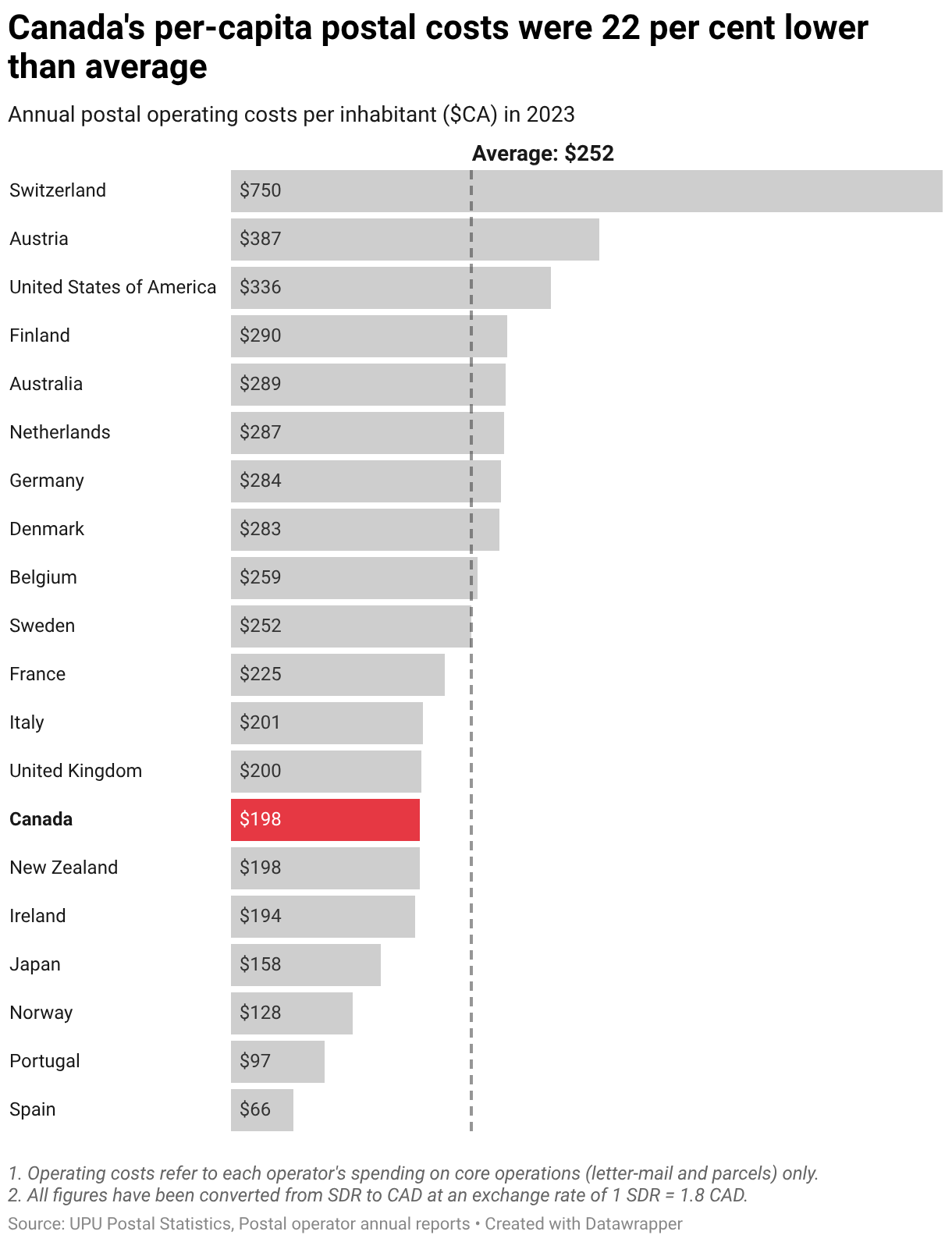
In the chart below, we can see the population-adjusted operating costs of the postal service in each country in 2023. Across the group, the average operating cost was $252 per resident—about 70 cents per person for each day of the year.
Canada Post’s operating costs of $198 per person—about 54 cents per person per day—fell below the group average by a healthy margin. On a per-person basis, Canada Post’s total spending on operations was 22 per cent lower than the average among peers.
Canada Post spends less per item mailed
Another obvious postal system cost driver is the volume of mail passing through the network. More mail volume means higher total costs, though sufficient volume can unlock economies of scale that make the system more efficient per item.
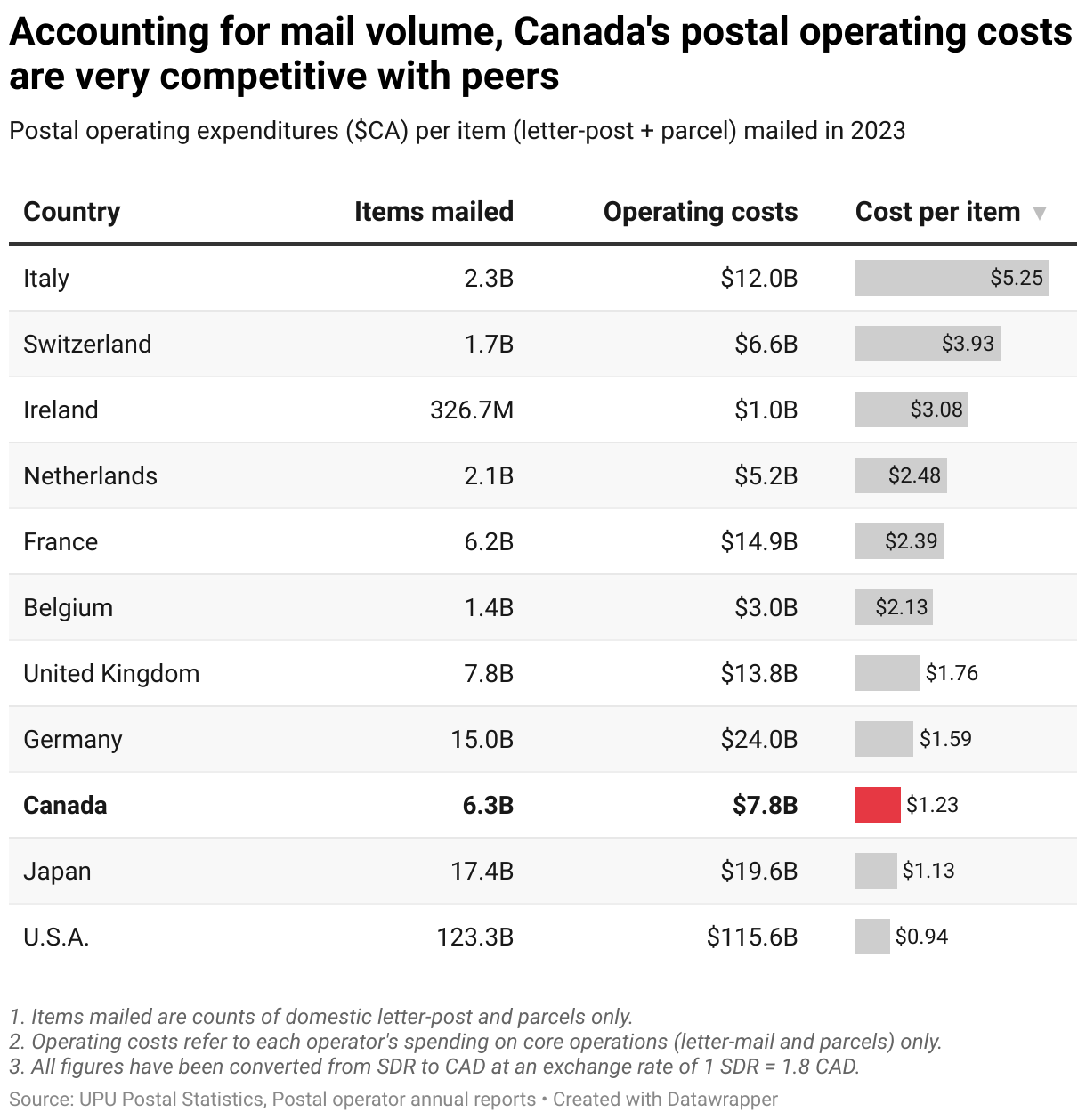
In the next table, we have adjusted operating costs by the total number of letters and parcels mailed domestically. Doing so cuts the comparison group size down to 10 countries plus Canada, because many lack data on mail volume.
Canada Post’s core costs per item mailed are very low compared to peer postal services. Among these countries, the average cost was $2.36 per item mailed. Canada Post’s spending per item mailed was only $1.23, which was 48 per cent lower than the group average. This certainly deflates the common assertion that Canada Post is “too expensive” to operate because of an “outdated delivery model.”
Given the challenge of serving Canada’s gigantic land mass, it would be quite reasonable to expect our postal service to be more expensive to operate than most other postal services. Yet that is clearly not the case.
The self-defeating nature of postal spending cuts
Canada Post’s operating costs are already low, so there is little to no room to cut them without impacting core services. Major cost-cutting measures risk triggering a downward revenue spiral that will harm the company’s financial sustainability potential in the long run.
According to research done by the UPU, postal services that responded to the decline in letter-mail by closing post offices to cut costs had greatly reduced revenue performance, hampering long-term efforts to reduce letter-mail dependence through diversification.
When an operator closes a post office, it no longer has to pay the costs of running it. At the same time, it loses much of the revenue generated from the office. If service cuts make the system less convenient and reliable, customers will likely seek alternatives, putting even more revenue at risk going forward.
Among our peer group, revenue and spending were tightly correlated—where one goes, the other usually follows close behind. Falling revenues can put pressure on managers to cut costs. On the other hand, spending on new or enhanced products and services can support revenue growth.
We compared the core postal revenue and spending of operators in 2013 and 2023, after adjusting for inflation—as before, we focus on spending and revenue from letters and parcels only.
While all postal services in the group faced declining letter-mail revenue, the impact on companies’ bottom lines varied. Just five operators had increased their real revenues, in Australia, Ireland, New Zealand, Sweden and Switzerland—all five of which had also grown their spending at the same time.
Conversely, nearly every operator that reduced real spending also suffered a major decline in revenue. The table below lists the operators that significantly reduced their spending since 2013, showing the percentageper cent change in revenue and spending over time. Across the cost-cutters, average spending fell by 22 per cent, while revenues fell by 23.8 per cent, for a difference of 1.8 percentage points.

When postal services cut spending over time, the total revenue loss was typically larger than the total reduction in costs, leaving company finances worse off than before, sometimes considerably so. Among the cost-cutting operators, real revenue losses were 24 per cent larger than cost reductions—meaning if costs were cut by $100, revenue, revenue also dropped by $124.

Only three operators in the group managed to come out ahead on cost-cutting.
One was Denmark’s PostNord, which came close to break-even and is now abandoning mail delivery entirely. The next, Post Italiane, receives about half of its revenue from inter-group transactions, mostly with their highly successful postal bank, BancoPosta. Without those internal sales, the operator’s revenue drop of 45 per cent greatly outweighs the drop in spending.
The only notable “success” was Finland’s Posti, with revenue losses that were 40 per cent lower than cost cuts—losing only 60€ in revenue for every 100€ in cost reductions. How did they accomplish this?
Austerity: When the best-case outcome is a cautionary tale
Posti stands out as a cautionary tale on the dangers of postal austerity, where the time horizon for cost-cutting goes back much further than 2013. Company managers pursued harsh cost-cutting measures and mass layoffs for decades in response to declining letter-mail. As a result, nearly all of the country’s post office network had been privatized. The size of Posti’s workforce was cut nearly in half, from 28 thousand employees in 2008 to just 15 thousand in 2024.
That agenda culminated in 2019, when the company planned to reorganize their parcel services—which they were now betting their future on—seeking “similar terms of employment” as their highly exploitative competitors in the parcel sector.
To the shock of many, managers intended to involuntarily transfer 700 parcel processing workers to a company-owned subsidiary. The transition to the new collective agreement amounted to a dramatic 30 to 50 per cent pay cut for most workers.
Finland’s postal workers called a nation-wide strike in response. Unions in other sectors like transportation, logistics, and public services joined in solidarity. The situation quickly escalated to a general strike that brought the country to a halt.
Government officials and company managers were unable to resist the combined strength of the working class. They dropped their ill-advised plans yet still paid a heavy political price. It became a national scandal, leading not just to the resignation of the responsible minister, but the prime minister as well.
What was the pay-off for such postal austerity measures? After embarking on a generation-long cost-cutting agenda, Posti has underperformed its peers in net profitability. In the early 2010s, the company was not particularly profitable, nor was it losing large sums of money. Postal austerity did not do much to improve on those results.

Meanwhile, the operator had eliminated so many jobs, it began having difficulty providing basic services in the mid-2010s, damaging public trust in the provider. Round after round of service cuts followed. The operator’s entirely outsourced post office model has long been struggling to provide universal coverage to Finland’s rural and remote areas. In 2024, company managers announced more layoffs in search of “flexibility” and “efficiency.”
Canada Post needs to be bold and invest in its future
Canada Post is an efficient operator among its peers. It costs less to operate per person and per item mailed, even though it serves a sparse population across one of the largest and most rugged land masses in the world.
If there is a spending problem, it is that not enough has been done, particularly by the federal government, to create and grow new revenue streams.
Among peers, there was not a single instance of an operator successfully cost-cutting their way to profitability on their core services. There is no path to prosperity for Canada Post that involves hacking away at services to cut costs—that can only be a path of managed decline.
Instead of cuts that will further erode revenue, we should be discussing investments for Canada Post to diversify and expand its business, exploring options in sectors like banking, insurance, logistics or telecommunications. Beyond that, there is ample opportunity to leverage the nation-wide infrastructure of the postal network to provide new and better public services to Canadians.